

Life in a neurodivergent family can feel like a whirlwind—especially when a child goes through puberty, or has special educational needs, or when characteristics of Pathological Demand Avoidance (PDA) are part of the mix or when highlights of the year are approaching like Christmas or our child’s birthday or anything that our child experiences as stressful. Whatever the situation, the smallest suggestion can feel overwhelming, and traditional approaches often don’t work. What our children need most is space, safety, and low-pressure support.
That’s where the 4-7-8 breathing technique comes in to create space, to help ourselves and our children to step out or stay out, the cycle of emotional and sensory overload. It’s not a demand, a lesson, or something to enforce—it’s simply a tool we casually use to stay grounded. By setting a gentle 4-7-8 Alarm, we create a calmer environment for ourselves, which naturally benefits our child. There’s no expectation for them to join in; they might notice, they might not. The goal is to model emotion regulation without pressure, so our children raise awareness about their emotional states and gather tools and develop strategies to find their own way to calm.
How this works for neurodivergent families
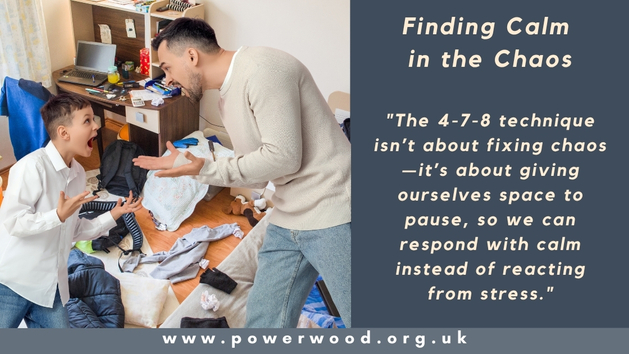
Neurodivergent children are often intense, sensitive, hyper reactive, and they might have high overexcitability (and we the parents might be too). These characteristics in combination with stress, not enough sleep, changing hormones because of puberty, worrying, mental health issues, PDA characteristics, anything challenging really, can make any well-meaning suggestion feel like a demand to our child, because they are easily triggered in a stress response. The 4-7-8 technique isn’t about adding another task to the list—it’s about giving ourselves a moment to reset, so we can show up as the steady, patient presence our children need.
When we use the technique, we’re modelling regulation without any demands. Our child might observe, or they might not—and that’s okay. The goal is to create a calmer atmosphere for everyone, without pressure.
How to use the 4-7-8 breathing technique
The basics:
- Place your tongue gently between your upper palate and front teeth. Keep it there throughout the exercise.
- Close your eyes if it feels safe and comfortable for you.
- Breathe in through your nose for a count of 4 (at your own pace—fast or slow, whatever feels natural).
- Hold your breath for a count of 7.
- Exhale slowly through your mouth for a count of 8.
- Repeat for three cycles.
Note: Your count will naturally adjust to how you’re feeling. If you’re stressed, it might be quicker; if you’re relaxed, it might slow down. Let your body guide the rhythm.
Important: If you feel the need to do another three cycles, take at least 4 deep, natural breaths in between to avoid lightheadedness.
When to use it: real-life moments
For us the parents and carers:
- When stress levels rise: We can set the alarm several days or even weeks in advance. We use the 4-7-8 technique where our child can see us, but without any invitation or expectation. This isn’t about them—it’s about us finding our calm, which helps them feel safer.
- During transitions: Set the alarm for 10 minutes before a transition (e.g., leaving the house, ending screen time). We use the technique to regulate ourselves first, creating a calmer atmosphere for our child.
- After emotionally draining moments: Whether it’s a meltdown, a tough conversation with school, or just a long day, a quick 4-7-8 reset helps us stay grounded—which helps our child feel more secure.
- When we’re running on empty: On days when everything feels impossible, the 4-7-8 technique is a tiny, achievable win—just for us.
For neurodivergent kids and teens:
- Make it part of the environment: We can use the 4-7-8 technique during low-pressure moments, like while we’re making tea or sitting in the car. There’s no need to explain or invite—we just breathe. If our child notices and asks, we keep it simple: “I’m just taking a moment to feel a bit calmer.”
- No demands, no expectations: Avoid any language that might feel like pressure. The goal is to normalise the technique as something that’s just part of our routine as a parent—not something they should do.
How we make it work for us
- We set the alarm for ourselves: We use a gentle, non-intrusive sound (or a visual timer) so it blends into the environment. This is our tool, not our child’s.
- We practice casually: We do the 4-7-8 technique without drawing attention to it. If our child is nearby, they might notice—but there’s no need to acknowledge it unless they bring it up.
- We let our body lead: Our count will naturally adjust to how we’re feeling. We trust our rhythm—there’s no “right” or “wrong” speed.
- We keep it low-key: The less fuss, the better. This isn’t a “lesson”—it’s just something we do for ourselves.
Why This Matters
For neurodivergent families, reducing demands while increasing safety and predictability is key. The 4-7-8 technique (and its alarm) gives us a way to:
- Stay grounded in chaotic moments.
- Model regulation without pressure.
- Create a calmer atmosphere for our child to thrive in—on their own terms.
This isn’t about perfection. It’s about giving ourselves (and our family) the space to pause, reset, and move forward with a little more ease.
©2025 Simone de Hoogh, senior coach, educational and parenting consultant, ECHA Specialist in Gifted Education* and founder of PowerWood. All posts by Simone de Hoogh
* Approved by the European Council for High Ability